Webinar Summary: The High-Yield Sponsorship: Architecting and Proving a 3x Return
Quick Summary & Key Takeaways
Featuring Mike LaPorta (Playbook for Health), Pete Falcone (JP Sports & Entertainment), Tim Syp (Verizon), and Tom Perros (rEvolution), moderated by C...
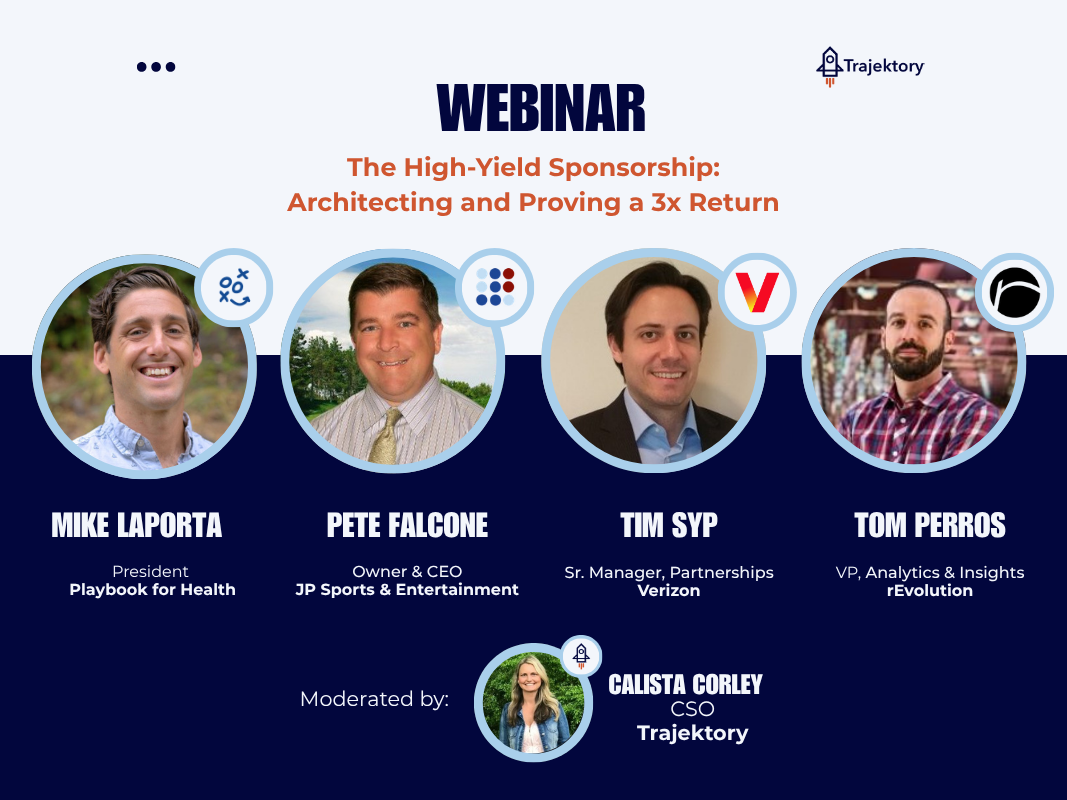
Featuring Mike LaPorta (Playbook for Health), Pete Falcone (JP Sports & Entertainment), Tim Syp (Verizon), and Tom Perros (rEvolution), moderated by Calista Corley (Trajektory).
Sponsorships used to be simple visibility deals. Today, they need to drive measurable business impact—but many brands are still struggling to connect the dots. In this webinar, industry experts from Playbook for Health, JP Sports & Entertainment, Verizon, and rEvolution explored how brands and agencies can move sponsorships beyond simple visibility, converting insights into measurable business impact. The discussion centered on defining success early, optimizing cross-channel value over time, and building measurement frameworks that support both short-term adjustments and long-term brand goals.
Using examples from healthcare partnerships, Verizon's sponsorship strategy, and broader agency work across brands and rights holders, the panelists demonstrated how they evaluate sponsorship value. They highlighted that value depends not just on assets, but on alignment, flexibility, and the ability to connect data to business objectives.
What Does High-Yield Sponsorship Really Mean?
There is a core tension in the market: many sponsorships were originally built as visibility deals, but organizations now expect them to produce clearer outcomes. Across the panel, the message was clear: high-yield sponsorship starts by defining what success actually means for the organization before trying to measure return.
Pete Falcone put a useful framing on this early, noting that while everyone talks about ROI, teams also need to focus on "return on objectives" and make sure goals are clearly established at the outset. Mike LaPorta reinforced that point by describing how sponsors increasingly want to understand not just impressions, but what a partnership is truly doing for the organization and community.
As Pete said, "everybody talks about ROI, but the more important starting point is often return on objectives." Mike added that these partnerships are "way more meaningful in the community beyond just the signage assets."
Takeaway: High-yield sponsorship begins with internal alignment on objectives, not with a return multiple.
Getting Started: From Visibility to Outcomes
Organizations often get stuck when they inherit or maintain sponsorships that were justified historically by logo presence, executive preference, or market visibility. The panel's advice was to step back and reassess what the sponsorship should now deliver.
Mike LaPorta described how healthcare organizations increasingly want to understand what partnerships are doing beyond signage, including effects on community benefit, health outcomes, employee engagement, and recruitment. Tim Syp shared that Verizon has shifted away from pure logo placement toward assets that help communicate messages, support calls to action, and enable experiential engagement.
In Tim's words, Verizon is focused on "what assets can actually help us communicate a message" and where the brand can "put a call to action." Tim pointed to Verizon's own naming-rights history as a concrete example of that shift: "The last major venue we were a naming sponsor for was the Verizon Center in DC — that switched over to Capital One Arena. We're still partners with Monumental Sports to this day; we've just realigned our assets to something that better suits our needs now." That reflected a broader shift away from awareness alone and toward assets that can actively support business priorities.
Takeaway: The first step is not adding more assets. It is clarifying what the partnership is supposed to achieve.
Structuring Sponsorships for Success
Success criteria should be built into the deal structure early rather than addressed only at renewal. The group discussed the importance of communicating objectives clearly to the property, embedding relevant assets in the contract, and making the relationship a team effort from the start.
The conversation also highlighted that seemingly minor assets can become especially important later because they map directly to renewal discussions or business outcomes. Inherited deals, where strategy and negotiation happened before the current team got involved, were described as particularly difficult because brands then have to reverse engineer value after the fact.
Mike emphasized the importance of getting aligned with properties early and being explicit about what success will look like over time. Pete added a useful reminder that inherited deals often create a "what the heck do we do with it?" moment, which is exactly why front-end structure matters so much. He pointed to a real example of how structuring has to account for more than the numbers on the page: "There was a firm owned by a private equity firm whose principal also owned a professional team. Our job was to make sure it actually worked for both sides — and that meant more than just dollars and cents."
Takeaway: The best time to define sponsorship value is during strategy and negotiation, not after activation begins.
Optimizing Cross-Channel Value
Cross-channel sponsorship measurement is now more possible and more complicated. The panel noted that brands have access to more data than ever across social, broadcast, experiential, and other channels, but more data alone does not create clarity.
Tom Perros emphasized that the key challenge is bringing disparate data sources into one cohesive story. Tim echoed that this requires the right experts across media, social, and experiential teams, while Mike added that the same metric can mean different things to different internal stakeholders depending on the function using it.
Tom captured the tension well: "people will confuse more data with better measurement" when, in reality, "more data could make measurement harder." Mike put the stakes of that confusion in concrete terms: "You present to a CFO: 'we got $10 million of media value from this signage.' The first question you get back is, 'that's great, but what does that actually mean for our bottom line?'" His point underscored the need for a more holistic measurement lens rather than isolated channel-by-channel reporting.
Takeaway: Cross-channel measurement works best when brands connect multiple data sources into one business narrative.
What to Do When an Asset Underperforms
The panel spent significant time on underperformance and how brands should respond when an asset does not deliver as expected. The advice was consistent: do not panic, diagnose the issue first.
Potential causes discussed included fulfillment issues, activation issues, injuries, poor creative, weak camera exposure, and broader external circumstances. The panel urged brands and agencies to distinguish between tactical problems that can be fixed quickly and larger strategic issues that require a bigger shift. Tim laid out that distinction as a practical first question to ask: "Is this a simple pivot — like, socials underperforming, so put some paid behind it? Or is it a bigger issue that moves from a tactical switch to a long-term strategic shift?" Mike offered a concrete illustration of how granular that diagnosis can get: "Sometimes it's as simple as the camera angle being slightly off on your in-venue signage, or your logo just didn't get picked up enough for people to recognize the activation."
Pete offered one of the clearest real-world examples here, noting that when deals involve individual athletes, "people get hurt or they don't play well," which can force brands to rethink how they extract value midstream. Tom's advice was simple and practical: "not panicking first and foremost" and taking a step back to understand the cause before deciding whether the fix should be tactical or strategic.
Takeaway: Underperformance should trigger diagnosis and recalibration, not panic.
Benchmarking: How to Know What "Good" Looks Like
The webinar then turned to one of the hardest questions in sponsorship measurement: how to judge whether performance is actually good. The panel described brand lift studies as one useful benchmark, especially when run preseason, midseason, and postseason to measure favorability, purchase intent, and competitive movement over time.
Other useful comparisons included fans versus non-fans, competitor performance, and broader contextual benchmarks by category, asset type, or league. At the same time, the speakers cautioned against relying too narrowly on "same category, same league" comparisons, noting that sponsorship competes with the rest of the marketing mix, not just with other sponsorships.
Tim pointed to brand lift studies as especially useful for understanding whether exposure is translating into favorability or purchase intent. Mike added that fans versus non-fans can be a strong signal for whether a sponsorship is moving the needle, and cautioned against reading a competitive gap as automatically negative: "Even if you're underperforming against a competitor, that's not automatically bad — if you're an academic medical center, you're already the trusted name tied to the university. Cutting into market share with any fan base is a win." Tom reminded the audience that "there's like never perfect apples to apples comparison" in sponsorship benchmarking.
Takeaway: Benchmarking works best when it uses multiple points of comparison instead of narrow comp sets.
Why Flexibility Has to Be Built In
The best sponsorships are designed to evolve. The panel described the use of asset recalibration checkpoints, mid-year reviews, quarterly monitoring, and annual reviews to catch issues before renewal and make improvements while the deal is still active.
Tim noted that many multi-year deals now include asset recalibration points because business priorities change over time. Mike added that some teams monitor performance and make adjustments in the first year itself, not as an overreaction, but because early data can reveal where a logo placement, message, or activation is not working as intended.
As Tim put it, "business priorities change, objectives change," so flexibility has to be built in from the start. That idea reinforced a larger theme from the session: sponsorship optimization works best when it is planned, not improvised.
Takeaway: The most effective sponsorship strategies build optimization into the contract and operating rhythm.
Balancing Short-Term ROI and Long-Term Brand Goals
The final major discussion focused on how to balance immediate performance expectations with longer-term brand building. The panel agreed that sponsorship is not a sprint and that year one is often a learning year, especially for brands newer to the space.
The speakers also noted that sports sponsorships are inherently seasonal. A single point-in-time read can be misleading, and periods like playoffs can create disproportionately high exposure. While short-term campaign or activation measurement remains valuable, the panel argued that long-term outcomes should carry more weight in evaluating sponsorship success.
Tom noted that brands can sometimes bring an "impatience to see immediate results," but cautioned that sponsorship "works best when it is broad and it works long term." Tim added that sponsorships have "inherent cyclical seasonality," which makes holistic evaluation more useful than judging performance at a single moment.
Takeaway: Short-term measurement matters, but sponsorship value should be judged holistically and over time.
Final Takeaways
Three consistent lessons emerged from the conversation:
Define objectives before measuring return. Use real-time and cross-channel data to optimize without overreacting. Build flexibility, recalibration, and long-term thinking into every sponsorship strategy.
Calista Corley's closing comments tied the discussion back to the broader market and to Trajektory's role in it. She noted that sponsorship revenue is "increasing drastically" and described the market as being on a "hockey stick growth" curve. Her summary brought the conversation back to a practical point: organizations now have more real-time visibility than ever, which means they have more control than they may realize over how sponsorships perform and evolve.
As Calista put it, "you don't have to panic," because the industry now has the data, tools, and playbooks to pivot quickly when needed. In that sense, the strongest sponsorship programs are no longer just the ones with the most visibility. They are the ones built around clear objectives, measured across channels, and optimized continuously over time.